编者按:
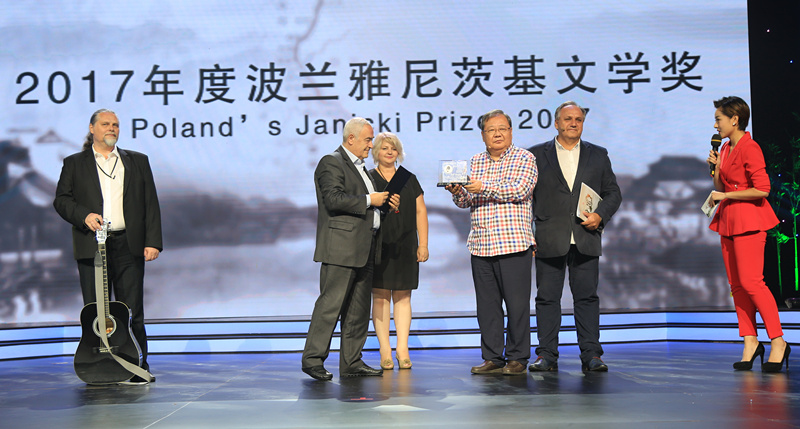
雅尼茨基文学奖于20世纪90年代初期创立于波兰,由季刊《隐喻》出资赞助。该刊编辑去世后,该奖项改由哲学艺术季刊《主题》主办。该奖有国际特色,推动了艺术、文学和音乐及新闻报道的原创性、创造性活动。该奖项现在的评委会包含来自不同国家的知识分子、作家、教授、评论家和艺术家。6月22日,2017年度波兰雅尼茨基文学奖授予中国诗人吉狄马加。在颁奖仪式上,吉狄马加以《向河流致敬,就是向诗歌致敬》为题致辞,下为全文。
向河流致敬,就是向诗歌致敬
——在2017年度波兰雅尼茨基文学奖颁奖仪式上的致辞
吉狄马加
尊敬的雅尼茨基文学奖的各位评委,尊敬的各位女士、各位先生、各位朋友:
今天我们大家从四面八方来到了这里,现在就置身于中国最古老的人工运河之一,京杭大运河的岸边,共同来见证这样一个对我而言十分重要的时刻,不知道为什么当看见身旁这条已经流淌了一千多年的河流,我突然想到了中国人经常说的一句话“山不转水转,水不转人转”,其实,眼前的现实就已经不折不扣地证明了这句话的正确,正是因为诸位从不同的地方,甚至从十分遥远的地方来到这里,才让我们的相见和邂逅充满了某种不可预知的感觉,尤其是这条河流的影子通过阳光,被再次反射到我们眼里的时候,我们不能不相信人类的诗歌与河流从来就是一对孪生姐妹,它们旺盛蓬勃的生命都来自于共同的自然和精神的源头,难怪在中国哲学中有“上善若水”的表述,其实诗歌和水所隐含的形而上的精神意蕴,就完全代表了人类至真至善至美的最高境界。我们不能想象,在人类能够繁衍生息的任何一个地方,如果没有河流和洁净的水,人类的思想、哲学和诗歌还能在漫长的时间中被滋养和孕育吗?也正因为此,从某种意义而言,我们向河流致敬,其实就是向诗歌致敬,我们向水致敬,其实就是在向一切伟大哲学致敬。朋友们,为此,我要由衷地感谢京杭大运河国际诗歌大会为我提供了一个特殊的颁奖地,当然我更要感谢波兰克莱门斯·雅尼茨基文学奖的诸位评委,你们从遥远的地方给我带来了一份如此厚重的礼物,除了让我感到激动和幸福之外,我的内心也有某种的不安,作为一个诗人面对你们赠予的荣誉,我确实无以回报。因为我知道这个奖项,是以16世纪波兰文艺复兴时期的人文主义者,最杰出的拉丁语诗人克莱门斯·雅尼茨基的名字命名的,它创立于20世纪90年代初,这个奖项已经颁发了20多年了,波兰有许多重要的作家、诗人和艺术家都获得过此项奖励,近两年此项文学奖开始面向国际颁发,十分荣幸的是因为评委会的慷慨和选择,我的名字已经和这个奖项永远联系在了一起。朋友们,不知你们是否真的理解,我为什么如此看重这份荣誉。那是因为作为诗人,我对波兰这个产生伟大诗人的国度充满着敬仰,对这片土地所承受过的苦难、悲痛和不幸,有着切肤的理解和同情,我曾经告诉过一些朋友,如果把现代波兰诗歌,放在20世纪以来的世界诗歌的天平上,波兰诗人和诗歌所创造的辉煌,都是令人赞叹和瞩目的,这些诗歌就像粗粝的含金矿石,将毫无悬念的将天平压倒在他们的一边。今天的这个世界并不太平,人类并没有消除核武器的威胁,同时不安全的其他因素也还在上升,如何进一步增进不同文明和文化的对话与交流,仍然是我们今天不同民族和国家的诗人的神圣责任,我相信越是在一个需要包容、沟通和相互尊重的时代,诗歌的作用就将会越发显现出来,朋友们,难道不是吗?今天正是因为诗歌,我们才相聚到了这里,这就是诗歌不可被替代的作用。谢谢大家!
2017年6月22日
A Salute to Rivers Is a Salute to Poetry
—Acceptance Speech for Poland’s Janicki Prize, 2017
Jidi Majia
Respected judges of the Janicki Literary Prize; respected ladies and gentlemen; friends in the audience:
Having gathered here today from all corners of China and the world, we find ourselves on the bank of an ancient waterway, the Peking-Hangzhou Canal. We are here to witness an occasion that is tremendously important for me. I’m not sure why, but looking at this waterway that has flowed for over a thousand years makes me think of an adage we often hear from the mouths of Chinese people: “The mountains do not revolve, but water does; water does not revolve, but people do.” Indeed, the reality before our eyes inarguably proves the correctness of this saying. Precisely because we have come from so many places, some of them quite remote, our encounter here is like a collision with the unknown. Especially as dappled sunlight is reflected from the river into our eyes, we cannot help believing that poetry and rivers are like two sisters, born as fraternal twins. Both surge with a vigorous life-force that comes from common spiritual and natural wellsprings. No wonder we find this adage in Chinese philosophy: “the highest good is like water.” In fact the metaphysical purport of both poetry and water represent the highest plane of human truth and goodness. We cannot imagine, in any place where people were able to flourish, that human thought and poetry could have been incubated over long periods without the pristine water brought by rivers. Precisely for this reason, our salute to rivers is, in some respects, a salute to poetry. When we offer salutations to water, we are really offering salutations to great philosophical thinking. And so, my friends, I want to express heartfelt gratitude to the Peking-Hangzhou Canal International Poetry Gathering for providing this wonderful site for receiving a prize. Of course I want to thank the judges of Poland’s Klemens Janicki Literary Prize for bringing me such a precious gift. Aside from feeling deeply stirred and blessed, I feel a tinge of unease within my heart, because as a poet I have no way make recompense for this honor you are bestowing on me. As you know, this prize is named after Klemens Janicki, a humanist in Poland’s 16th century Renaissance who was an outstanding Latin poet known as Ianicius. After its founding in the 1990s, the prize has been awarded for over twenty years, and its recipients include many of Poland’s most famous writers, poets and artists. Only in the past year or two has this prize broadened its scope to international recipients. I am greatly honored that, due to the generous decision of the judging committee, my name will forever be linked with this prize. My friends, I don’t know if you truly grasp why I value this prize so highly. As a poet I am filled with admiration for Poland—a country which has produced so many great poets. I have visceral awareness and sympathy for the terrible adversity and suffering which have been visited upon Polish soil. I used to tell my friends that if you place modern Polish poetry on the scale of world poetry since the 20th century, the brilliance of what was created in Poland will cause people to gasp in amazement. Their works are like coarse but rich gold-bearing ore, with weight that inevitably tips the scales in their favor.
Our world today is by no means peaceful, and humankind has not managed to phase out the threat of nuclear weapons. At the same time, other factors of insecurity are on the rise. The task of enhancing dialogue and exchange between different civilizations is more than ever a sacred duty for poets of different peoples and nations. I believe that the more an era needs tolerance and respectful communication, the more poetry’s function will manifest itself. Don’t you think so, my dear friends? It is precisely because of poetry that we are gathered here today. In this we see poetry’s irreplaceable function. Thank you, everyone.
June 22, 2017
2017年度波兰雅尼茨基文学奖
Poland’s Janicki Prize, 2017
(2017﹒6﹒22)

雅尼茨基文学奖:
雅尼茨基文学奖于20世纪90年代初期创立于波兰,由季刊《隐喻》出资赞助。该刊编辑去世后,该奖项改由哲学艺术季刊《主题》主办。该奖有国际特色,推动了艺术、文学和音乐及新闻报道的原创性、创造性活动。
克莱门斯·雅尼茨基是波兰文艺复兴时期的代表人物,出身贫苦农家,离家后进入格涅兹诺和波兹南的学校就读。在波兹南的路布朗斯基学院,他在约翰·丹蒂夏克、斯坦尼斯劳斯·赫修斯主教、1536年曾任学校秘书的安德鲁·拉迪斯劳斯大主教的照管下学习。他在拉丁文文学领域表现突出,克拉科夫省行政长官彼得·克米塔将他带到自己的官邸,帮助他全面发展。在一位富人赞助下,他到帕多瓦游学,并于1540年在帕多瓦大学获得哲学博士学位。教皇保罗三世封他为桂冠诗人(该头衔相当于拉丁语时代的诺贝尔文学奖)。回到家乡后,他成功地创作了多种诗歌。1543年他在克拉科夫去世,并被埋葬在那里。克莱门斯·雅尼茨基文学奖首任评委会主席是波兰作协主席彼得・昆采维奇(Piotr Kuncewicz,1936-2007),波兰作家、诗人杨・古莱茨-罗辛斯基(Jan Górec-Rosiński,1920-2012),耶日・苏里玛-卡明斯基(Jerzy Sulima-Kamiński,1928-2002),安杰伊・K.瓦希凯维奇(Andrzej K. Waśkiewicz,1941-2012),尼科斯・哈基尼科拉乌(Nikos Chadzinikolau,1935-2009)等都曾担任过评委会主席和评委。波兰许多重要诗人和作家都先后获得过此奖,2015年度获得该奖的是波兰女诗人、文学评论家、翻译家、记者卡丽娜・伊莎贝拉・乔瓦(Kalina Izabela Zioła),从2016年开始,该奖项的评选范围已扩大到国际。
该奖项现在的评委会包含来自不同国家的知识分子、作家、教授、评论家和艺术家:大流士•托马斯•莱比奥达(评委会主席)、加吉克·达夫强(亚美尼亚)、瓦尔丹·哈科比安(卡拉巴赫)、林光美【音】(越南)、哈提夫·贾纳比(伊拉克)、梅廷·塞拉尔(土耳其)、克劳迪奥·波扎尼(意大利)、雅罗斯拉夫·皮亚罗夫斯基(波兰)、维斯拉夫·马尔西夏克(波兰)。
IANICIUS PRIZE
Ianicius Prize was initiated in Poland the early nineties of the twentieth century and was granted by the quarterly magazine "Metaphor." After the death of the editor of this journal, he passed under the wing of the quarterly philological-art "Theme", which will be admitted annually. Now Prize have international character and promotes original artistic creativity in art, literature and music, as well as in journalistic activity. Klemens Janicki (Ianicius) was Polish humanist Renaissance period in Europe. He came from a poor peasant family, and after leaving the family home, he attended the school of Gniezno and Poznan.
Educated in Lubranski Academy in Poznan, he has gained custody of John Dantyszek, Bishop Stanislaus Hosius, Archbishop Andrew Ladislaus, which was secretary in 1536. In recognition of his services in the field of Latin literature, Krakow province governor Piotr Kmita, took him to his court and allowed the all-round development. A wealthy patron facilitated him a trip to study in Padova, where in 1540 he received a degree of Doctor of Philosophy at the University of Padova. Pope Paul III bestowed him a poetic laurels and gave the title: Poetae laureatus (It was like Nobel Prizes in latin language times). After returning home, he created with great success the songs of many species. He died in 1543 in Krakow and was buried there. The first President of the Chamber of Ianicius Prize was Piotr Kuncewicz (1936-2007), President of Polish Writers' Union. Some other Polish writers and poets, including Jan Górec-Rosiński (1920-2012), Jerzy Sulima-Kamiński(1928-2002), Andrzej K. Waśkiewicz(1941-2012)and Nikos Chadzinikolau(1935-2009), once served as President or member of Chamber of Prize. Many important poets and writers of Poland have been the laureates of this prize. Ms. Kalina Izabela Ziola, a Polish poet, literary critic and translator, has won the prize in 2015. Since 2016, the range of candidates of the prize has extented to foreign writers.
In present Chamber of Prize are international intellectuals, writers, professors, critics and artist: Dariusz Tomasz Lebioda (President), Gagik Davtian (Armenia), Vardan Hakobyan (Karabach), Lam Quang My (Vietnam), Hatif Janabi (Irak), Metin Celal (Turkiye), Claudio Pozzani (Italy), Jaroslav Pijarowski (Poland), Wieslav Marcysiak (Poland).
{Content}

除每日好诗、每日精选、诗歌周刊等栏目推送作品根据特别约定外,本站会员主动发布和展示的“原创作品/文章”著作权归著作权人所有
如未经著作权人授权用于他处和/或作为他用,著作权人及本站将保留追究侵权者法律责任的权利。
诗意春秋(北京)网络科技有限公司
京ICP备16056634号-4 京ICP备16056634号-1 京ICP备16056634号-2 京ICP备2023032835号-2
 京公网安备11010502034246号





所有评论仅代表网友意见